
Home / Solutions / Carbon Credits
Carbon credits
Buy credits as one managed part of a wider climate plan.
Our carbon credit fundamentals
We help organisations acquire high-integrity carbon credits aligned with genuine corporate climate strategy.
High integrity credits
We assess quality before you commit, from methodology to verification.
Carbon removals
Understand removal options, their costs and how long the benefit lasts.
Buying strategy
Set volumes, budgets and timing that fit your targets.
Environmental commodities across Asia Pacific
Access high-integrity environmental commodities through connected registries, transparent price discovery, and full serial number custody tracking.
Nature-Based & Tech Credits
Verified carbon units from peatland rewetting, afforestation, blue carbon mangroves, biochar, and industrial removals across Southeast Asia and international standards.
Energy Attribute Certificates
Standardized International Renewable Energy Certificates (I-RECs) and TIGRs sourced from verified solar, wind, and run-of-river hydro plants across APAC.
CORSIA & SAF Attributes
ICAO-eligible carbon units for airline compliance periods alongside book-and-claim Sustainable Aviation Fuel (SAF) greenhouse gas accounting.
CIX Contracts & Carbon Tax Offsets
Standardized carbon contracts traded on Climate Impact X (CIX) and eligible International Carbon Credits (ICC) for compliance offset under Singapore Carbon Pricing Act.
SPE-GRK National Credits
Sertifikat Pengurangan Emisi Gas Rumah Kaca (SPE-GRK) registered under the Indonesian National Registry System (SRN-PPI) and traded on IDXCarbon.
Australian Carbon Credit Units (ACCUs)
High-integrity ACCUs generated through Indigenous savanna fire management, Human-Induced Regeneration (HIR), and soil carbon projects in Australia.
HKEX Core Climate Carbon Contracts
High-quality international and regional voluntary carbon credits traded on HKEX Core Climate, settled in HKD and RMB for cross-border and Greater Bay Area finance.
TCX Domestic & International Credits
Verified carbon units traded on Taiwan Carbon Solution Exchange (TCX), structured for Taiwan Climate Change Response Act compliance and corporate fee deduction.
Vietnam Mitigation Units & Quotas
Domestic carbon credits and mitigation quotas developed under Vietnam Decree No. 06/2022/ND-CP covering renewable energy, forestry, and industrial efficiency.
Lao PDR Sovereign Article 6 ITMOs
Internationally Transferred Mitigation Outcomes (ITMOs) under Paris Agreement Article 6.2, cross-border clean hydropower, and forest conservation carbon rights.
DENR CAVCS Nature & Blue Carbon
Certified carbon mitigation outcomes registered under the Carbon Accounting, Verification and Certification System (CAVCS) for forest and coastal mangrove conservation.
BANI Arbitration & Title Protections
Institutional legal dispute resolution and arbitration framework safeguarding cross-border forward purchase agreements (ERPAs), title transfers, and custodian rights.
The AION 5-step carbon quality matrix
We review every carbon asset against strict Core Carbon Principles (CCP) and local regulatory standards before capital is committed.
Proof that project activities exceed legal requirements and would not proceed without carbon market revenue support.
Comprehensive reversal risk assessments, 100-year commitment periods, and mandatory contributions to registry buffer pools.
Defensible counterfactual deforestation and emissions modeling to eliminate over-crediting and data inflation risks.
Ground-truth calibration verified by high-resolution optical and radar satellite imagery, IoT sensors, and hydrological telemetry.
Written Free, Prior, and Informed Consent, community benefit agreements, and UN Sustainable Development Goal validation.
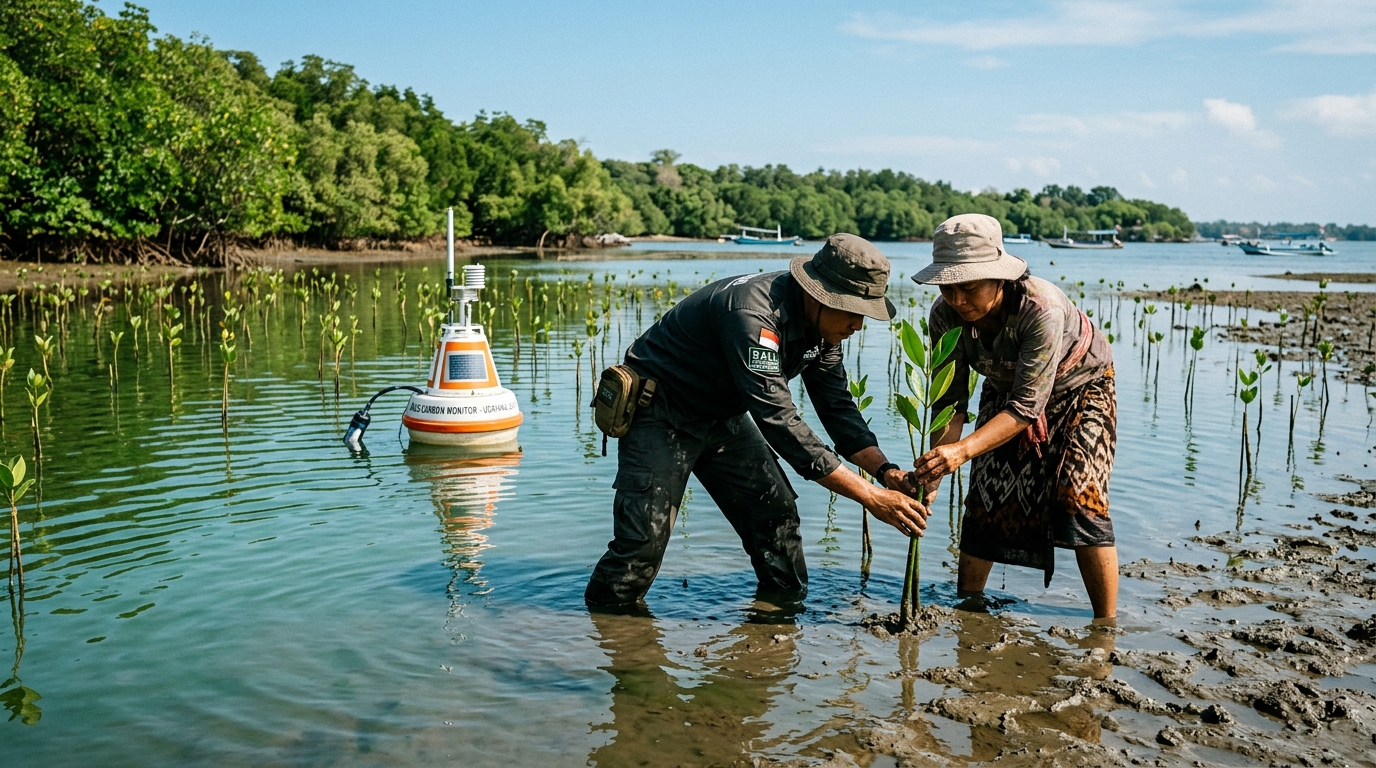
Why quality due diligence precedes every trade
Carbon markets only deliver value when corporate buyers and their stakeholders can rely on what they are getting. AION acts as an independent quality filter across voluntary and compliance markets in Asia Pacific.
Frequently asked questions about carbon credits
A comprehensive guide to carbon markets, procurement steps, quality criteria, and regional regulations across Asia Pacific.
Carbon Market Foundations
A carbon credit represents a certified and audited reduction, avoidance, or removal of one metric tonne of carbon dioxide equivalent (1 tCO2e) from the atmosphere. Credits are generated by verified environmental projects (such as peatland forest conservation, mangrove blue carbon restoration, or biochar production) adhering to recognized international standards like Verra's Verified Carbon Standard (VCS) or Gold Standard.
Beyond climate impact, high-integrity projects deliver measurable co-benefits for biodiversity and local communities. Once purchased to address residual emissions, a carbon credit is retired permanently on a public registry with unique serial numbers, ensuring it cannot be traded or claimed again.
Compliance carbon markets are mandatory, government-regulated systems where regulated high-emitting entities must meet legal emissions caps set by law (such as the EU Emissions Trading System, Australia's Safeguard Mechanism, or Indonesia's IDXCarbon power-sector cap). Entities that emit above allowances must purchase compliance units or face financial penalties.
The Voluntary Carbon Market (VCM) allows companies, institutions, and individuals to purchase carbon credits to meet corporate net-zero commitments and voluntary climate contribution targets. These two markets are increasingly converging under Article 6 of the Paris Agreement, with governments establishing frameworks to integrate high-integrity voluntary units into national compliance schemes.
Standards bodies establish accounting methodologies, monitoring requirements, and social safeguard criteria that projects must follow. Independent third-party auditors (Validation and Verification Bodies, or VVBs) conduct validation before project implementation and periodic verification of measured emission reductions.
Sovereign registries, such as Australia's Clean Energy Regulator (ANREU for ACCUs) and Indonesia's Sistem Registri Nasional (SRN-PPI), ensure statutory oversight, clear land title alignment, and avoidance of sovereign double-claiming.
Buying and Selling Carbon Credits
We provide structured procurement tailored to corporate transition plans rather than one-off transactional trades. Our team begins by assessing your emissions profile, target years, budget, and geographic preferences.
We then conduct due diligence across our Asia Pacific project network, manage legal contracting, facilitate registry account transfers, and execute serialized retirements with public certificates for ESG and financial reporting.
Carbon credit prices vary depending on five primary market factors:
- Project Type: Permanent technical removals (such as biochar and direct air capture) command higher prices than nature-based avoidance due to permanence durability and capital investment.
- Standard & Methodology: Core Carbon Principles (CCP) eligibility, recent registry vintages, and high scores from independent rating agencies (like BeZero and Calyx Global).
- Verified Co-Benefits: Measurable contributions to United Nations Sustainable Development Goals (SDGs), community employment, and biodiversity preservation.
- Sovereign Approvals: Host country export authorizations and corresponding adjustments for cross-border transfers.
A structured transaction follows four disciplined stages:
- Technical & Legal Due Diligence: Verification of additionality, baseline assumptions, community consent, and buffer contributions.
- Commercial Purchase Agreement: Execution of forward offtake or spot settlement contracts with clear representations and warranties.
- Custodian Registry Transfer: Direct transfer into your organization's registry account on Verra, Gold Standard, ANREU, or IDXCarbon.
- Serialized Retirement: Permanent cancellation on public ledgers with designated beneficiary attribution to prevent double-claiming.
The Role of Carbon Credits in Net-Zero Strategy
Carbon credits complement direct decarbonisation rather than substituting for internal action. Leading frameworks such as the Science Based Targets initiative (SBTi) and the Oxford Principles mandate the mitigation hierarchy: companies must prioritize reducing operational and value chain emissions (Scopes 1, 2, and 3) by at least 90% by 2050.
Within this framework, credits serve two roles:
- Beyond Value Chain Mitigation (BVCM): Investing in external high-integrity mitigation while internal reductions take place.
- Neutralising Residual Emissions: Purchasing permanent carbon removals to balance remaining unabatable emissions when reaching net-zero.
A resilient corporate strategy includes:
- Strategic Sourcing: Prioritizing projects within supply chain regions or key operating markets across Southeast Asia and Australia.
- Portfolio Diversification: Balancing near-term nature-based conservation with scalable durable removals.
- Transition to Removals: Progressively increasing the proportion of permanent removals as corporate net-zero milestones approach.
- Auditable Governance: Board-level oversight and transparent public retirement registries to protect corporate reputation.
Quality, Additionality and Permanence
High quality requires satisfying the Core Carbon Principles defined by the Integrity Council for the Voluntary Carbon Market (ICVCM):
- Real: Reductions or removals must have actually taken place, proven by audited empirical field data.
- Additional: The environmental outcome would not have occurred without carbon market finance.
- Conservative Baselines: Defensible counterfactual baselines to eliminate over-crediting risks.
- Permanence: Measures must protect carbon storage over at least 100 years.
- Robust Safeguards: Free, Prior, and Informed Consent (FPIC), fair benefit sharing, and zero negative social or environmental impacts.
Additionality ensures project activities exceed standard business practice and require carbon revenue to proceed. Auditors apply three tests:
- Financial & Investment Barrier Test: Proof that project economics (e.g., preserving a concession versus harvesting timber) are unviable without carbon credit revenue.
- Regulatory Surplus Test: Confirmation that project actions exceed all existing national, provincial, and municipal legal obligations.
- Common Practice Test: Demonstration that the technology or conservation practice is not already widespread within that geographic sector.
Permanence relates to how securely carbon remains stored over centuries. For biological storage (forests, mangroves, soil), natural risks like forest fires or disease could cause reversals.
To mitigate this risk, certification registries mandate that projects deposit a risk-weighted fraction of their credits (usually 10% to 25%) into a central pooled reserve known as a buffer pool. If an unintentional reversal occurs, credits from this collective insurance reserve are automatically cancelled, preserving the environmental validity of every retired credit.
Leakage happens when conservation inside a project area inadvertently shifts emissions to adjacent land (e.g., loggers moving across a boundary). High-integrity projects incorporate regional leakage belts, monitor buffer zones via satellite radar, and invest in alternative local employment to neutralize economic incentives for deforestation outside the project perimeter.
Project Types and Co-Benefits
Climate projects are fundamentally categorised by their mitigation outcome:
- Carbon Avoidance / Reduction: Prevents greenhouse gases from entering the atmosphere in the first place. Examples include protecting intact tropical peatlands from being drained (avoided deforestation / REDD+) or installing solar arrays to displace diesel generators.
- Carbon Removal (CDR): Directly draws down atmospheric CO2 and stores it durably in biological sinks (such as mangrove blue carbon and afforestation) or engineered sinks (such as biochar and direct air capture).
Both are necessary: avoidance preserves existing planetary sinks today, while removals are vital to counterbalance residual emissions at the net-zero finish line.
Co-benefits are the measurable social, environmental, and economic benefits generated alongside emissions reductions. High-quality projects support United Nations Sustainable Development Goals (SDGs), including clean water protection, endangered species habitat preservation, gender equality initiatives, and direct local economic dividends.
These co-benefits are certified under specialized standards like the Climate, Community & Biodiversity (CCB) Standards and SD VISta.
A rigorous vetting checklist examines:
- Project Developer Track Record: Proven field experience and local community relationships.
- Standard & Methodology Version: Alignment with modern, conservative methodology revisions.
- Independent Rating Scores: Verification from ratings firms like BeZero Carbon and Calyx Global.
- Community Consent & Equity: Documented FPIC agreements ensuring revenue reaches local custodians.
Communicating Climate Actions & Avoiding Greenwashing
Credible climate communications require strict adherence to international disclosure frameworks:
- Align with the Voluntary Carbon Markets Integrity Initiative (VCMI) Claims Code of Practice.
- Keep internal operational reductions and external credit purchases distinctly separate in public disclosures. Never claim that buying credits excuses operational emissions.
- Publish complete registry data including standard names, project identifiers, vintages, and public retirement links.
- Present credit purchases as active contributions to global climate solutions and nature conservation.
Regulatory bodies in Europe, the UK, and Australia are tightening restrictions on generic "carbon neutral" marketing labels, which can mislead consumers into believing products have zero climate impact. The modern best practice is "Climate Contribution" or "Financing Verified Climate Action".
This approach accurately describes corporate funding of vital environmental projects without exaggerating progress on internal emissions abatement.
AION's Execution Across Asia Pacific
AION operates as an integrated regional climate advisory and carbon asset partner across 8 operating hubs: Singapore (Headquarters), Indonesia (Bali PT PMA Hub), Vietnam (Advisory & Energy), Laos (Project Development), Philippines (Transition Support), Australia (ACCUs & Decarbonisation), Hong Kong (Greater Bay & Green Finance), and Taiwan (Technology & Supply Chain). We bridge international corporate buyers with high-integrity project developers across Southeast Asia and the Pacific, providing ground-level technical due diligence, legal structure alignment, and direct registry execution.
Under Indonesian Presidential Regulation 98/2021 and Ministry of Environment decrees, all carbon projects within Indonesia must be registered in the Sistem Registri Nasional (SRN-PPI). International credit transfers require designated ministerial authorizations and benefit-sharing compliance to align with Indonesia's Nationally Determined Contribution (NDC).
AION PT PMA works on the ground in Indonesia to structure transactions that fully satisfy domestic legal requirements.
Yes. AION structures bespoke portfolios satisfying International Civil Aviation Organization (ICAO) CORSIA requirements, including authorized host-country corresponding adjustments, eligible crediting programs, and required vintage brackets. We also assist corporate clients and governments in navigating bilateral Article 6.2 authorizations and Article 6.4 mechanism guidelines.
Need a tailored carbon asset strategy?
Speak directly with our regional teams across Singapore, Indonesia, Vietnam, Laos, Philippines, and Australia. We will help structure a vetted, defensible carbon portfolio.